How an evaluation works
Audience: the PSP engineer who wires the authorisation flow to the Edge Node, and anyone who needs to explain why a transaction got its decision.
This document describes the behaviour of POST /edge/evaluate. It follows the code
(EdgeController, EdgeEngine, EdgeRuleInterpreter, AerospikeFeatureStore,
com.hokeka.edge.ledger), not intent. Where the code has a sharp edge, this document says so.
The Edge Node is the only component that evaluates transactions. The cloud does not
re-evaluate, re-score or override an Edge decision. The data rules that follow from this are in
EDGE_DATA_RESIDENCY_CONTRACT.md.
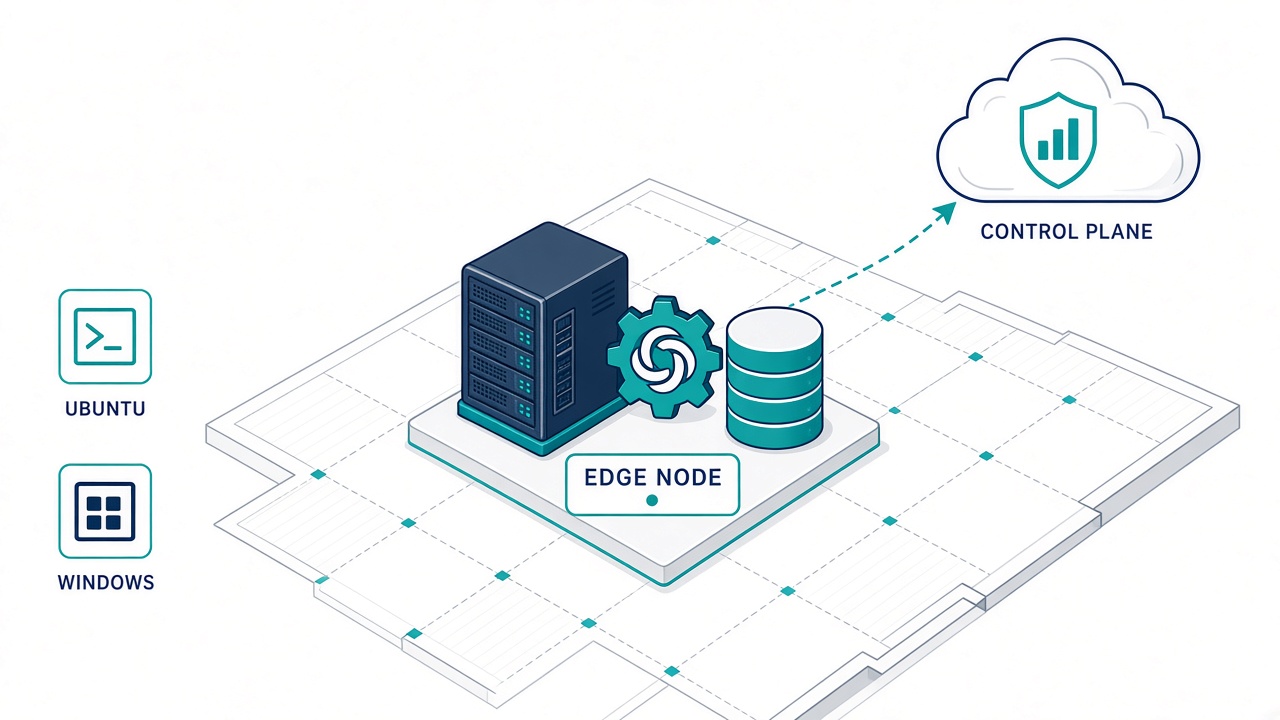
Figure 1 — One Edge Node. The 8443 evaluate API terminates TLS inside the process; the engine reads velocity buckets from Aerospike and writes every evaluation to the local Edge Ledger. Nothing in this box is reachable from the internet.
1. The request path end to end
Your API node
    │  POST /edge/evaluate      TLS 1.3, one virtual thread per request
    ▼
EdgeController
    │  0. CHECK txn_id: PAN-like → 422 TXN_REF_LOOKS_LIKE_PAN; malformed → 422 TXN_REF_INVALID
    │  1. read pan_hash from the body
    │  2. SCREEN: counterparty names against the in-memory sanctions list, merchant against the
    │     config blocklist (§6.2; in memory only, no I/O)
    │  3. ENRICH: derive history features from Aerospike (fail-closed if unavailable), then the
    │     compliance overlay: CTR card-day total, cash structuring, Edge Config limits (§6.1);
    │     derived and compliance features win over caller fields of the same name
    ▼
EdgeEngine
    │  4. GATE:   node authorized?      no → HOLD (no rules run)
    │  5. GATE:   rule bundle present?  no → HOLD (no rules run)
    │  6. EVALUATE via the Rust core, or the Java interpreter as warm standby
    ▼
EdgeController
    │  7. MERGE the rules', the overlay's and the screening's actions: strongest wins
    │     (BLOCK > SUSPEND > HOLD > FLAG > ALERT > ALLOW); a fail-closed HOLD stays HOLD
    │     then advance this card's history and the limit usage with the FINAL action
    │     (after the decision; site-scoped keys; a BLOCK from any source uses no limit)
    │  8. MINT edgeAssessmentId (UUID)
    │  9. RECORD on the Edge Ledger: evaluation row + txn_ref index + decision-record outbox row,
    │     one SQL statement, one local transaction. Failure → HOLD / LEDGER_UNAVAILABLE (§5.3)
    │ 10. count the standing decision into the aggregate metrics
    ▼
    └─► 200 OK  { action, score, triggeredRuleIds, reasons, triggeredRuleVersionIds,
                  edgeAssessmentId, ruleBundleVersion, ruleBundleHash }

Later, in the background:
    OutboxShipper drains edge_outbox → sealed decision record v2 batch →
    POST /api/v1/edge/assessments (Control Plane raises alerts and cases by reference)
Ordering details to know:
- Screening happens before anything is counted, so a sanctions or blocklist
BLOCKis known when limit usage is committed and consumes no limit. It reads only memory (the swapped list and the config in force), so it costs no store round trip. - Enrichment happens before evaluation, so rules see this card's history.
- History advances after evaluation, so stored counters never contain the transaction being
evaluated; the derivation then adds it explicitly where the cloud's windows did (§2.2), so
pan_txn_count_24h= earlier transactions + 1. The CTR card-day total is the exception: it is advanced atomically before evaluation, so concurrent nodes cannot both miss the crossing. - The ledger write happens before the answer. If the PSP gets an
edgeAssessmentId, that evaluation is on the ledger, or it is a fail-closedHOLDwaiting in the retry buffer (§5.3).
2. The request
POST /edge/evaluate, Content-Type: application/json.
The body is a flat JSON object of features. There is no fixed schema and unknown fields are not rejected: the body is a feature bag that rules run against. That has a sharp edge; see §2.3.
2.1 Fields the engine itself uses
The node reads these names directly. It passes every other field to the rules unchanged.
| Field | Type | Used for | If absent |
|---|---|---|---|
pan_hash | string | Velocity key; stored in its own ledger column (never in features, never sent to the cloud) | No velocity enrichment. Velocity rules cannot fire |
txn_id | string or integer | Your transaction reference. Stored as txn_ref, unique per Edge Site, sent to the cloud as txnRef | Evaluated and stored with no reference. You can then find it only by edgeAssessmentId |
amount_cents | integer (minor units) | Velocity amount counters; stored as amount_cents | Counters add 0; column is null |
merchant_id | string ^[A-Za-z0-9][A-Za-z0-9._:-]{0,63}$ | Stored; sent to the cloud as merchantId | Column is null |
currency | ISO 4217, 3 letters | Stored | Column is null |
country_code | ISO 3166, 2 letters | Stored | Column is null |
mcc | 4 digits (an integer is zero-padded) | Stored; rules often target it | Column is null |
channel | ^[A-Z][A-Z0-9_]{0,31}$ | Stored | Column is null |
A value that does not match its format is stored as null in its column. It still reaches the rules as you sent it.
txn_id rules. It must be 1 to 128 printable ASCII characters with no spaces. If it looks like a
card number (13 to 19 digits after removing spaces and hyphens, and it passes the Luhn check), the
node answers 422 {"error":"TXN_REF_LOOKS_LIKE_PAN"}. Any other invalid value gets
422 {"error":"TXN_REF_INVALID"}. In both cases the node evaluates nothing and stores nothing. If you
send the same txn_id twice, both evaluations are stored and the reference points at the newest one.
Send the PAN hash, never the PAN. The node strips card secrets before it stores features
(pan, card_number, cvv, cvc, track1, track2, pin, pin_block, expiry and similar keys,
plus any value the Luhn guard flags). Do not rely on that: a raw card number has no use here.
2.2 Features the node derives for you
The node reads the card's (and its device's and IP's) history from Aerospike in one batch get
and merges the derived features in before evaluation (CardHistoryFeatures, R10a). Names and
arithmetic are the cloud's (RuleFeatureEnrichmentService), so the compiled SpEL typology catalog
sees the same values the cloud rules saw. Counts and sums over a window ending "now" include the
transaction being evaluated, as the cloud's did (it stored the transaction before scoring);
features the cloud computed over earlier transactions only ("before now") exclude it.
| Derived feature(s) | Source | Meaning |
|---|---|---|
amount | request | amount_cents ÷ 100 (0 when absent), as the cloud's #tx.amount |
txn_direction | request | direction normalised: starts with IN or is CREDIT → INBOUND, else OUTBOUND |
amount_ending_pattern | request | amount ends in .00 or .99 |
pan_txn_count_1m, _5m, _1h | recent list | Rolling, exact, current included |
pan_txn_count_24h, pan_amount_sum_24h | hourly buckets | Last 24 UTC hourly buckets + current; sum in major units |
is_first_transaction, days_since_last_activity | card profile | No earlier evaluation on the site; whole days since the last one |
is_new_country, is_new_currency | recent list | No earlier evaluation with this country / currency in 30 days |
txn_count_deviation_ratio, volume_deviation_ratio | daily buckets | 7-day vs 30-day daily average (count / amount) |
avg_amount_spike_ratio, zscore_amount_vs_pan_history | daily buckets | Amount vs the card's 30-day mean; z-score with the population standard deviation (0 without history or spread) |
volume_ratio_t1_t2, txn_count_window_ratio, daily_txn_count_ratio, avg_amount_window_ratio, daily_avg_amount_ratio | hourly + daily buckets | The cloud's window ratios |
send_receive_ratio, spend_receive_spike_ratio | daily / hourly buckets | Rapid movement: outbound vs inbound count (7 d) and amount (24 h) |
same_parties_volume, circular_trading_count, refund_share_pct, round_value_share_pct, round_value_txn_count, unique_senders, unique_counterparties, distinct_banks, bank_name_changes, distinct_payment_ids | recent list | 7-day features over the card's remembered evaluations |
distinct_users_per_payment_id | device profile | Distinct merchants seen with device_id (else device_fingerprint) |
distinct_users_per_ip, payment_id_use_count, distinct_countries, ip_outside_expected_location, ip_change_count | IP profile | Merchants, 7-day uses and countries seen with ip_address |
cash_transaction, ctr_required, is_structuring_suspected, structuring_repeat_count_24h, structuring_amount_band | Edge Config + counters | See §6.1 |
anonymous_payment_screening_hit, reference_lc, device_key | request | Prepaid card_type, cash, or no customer_account_reference / account_id / customer_id / customer_email; lower-cased reference; device key |
A feature the cloud set only under a condition (e.g. avg_amount_spike_ratio only when the card has
a 30-day average) is set here under the same condition.
Unit mismatch. You send
amount_centsin minor units. The derivedamountandpan_amount_sum_24hare in major units.
Window resolution. 1 min / 5 min / 1 h are rolling and exact from the card's last 100 evaluations (when 100 fall inside the window, the count is bounded below by the current and previous hourly buckets). 24 h is the last 24 UTC hourly buckets, so it spans 23 to 24 hours; "yesterday" is buckets 24–47. 7 and 30 days are the current UTC day plus the 6 / 29 previous ones. The cloud's 30-day z-score used at most 1 000 amounts; the Edge uses all of them. "New country/currency" looks at the last 100 evaluations (the cloud looked at 200).
Cost. Before evaluation: one batch get of at most 82 keys (48 hourly + 31 daily buckets, card,
device and IP profiles). After it: two atomic adds (hour, day) and up to three generation-checked
profile writes (card, device, IP; each ≤ 100 entries, ~8 KB). With CTR on, a cash card transaction
adds one atomic operate; Edge Config limits add one batch get before and one add per applicable
limit after. No ledger query runs on the evaluate path. The in-process cost of deriving every
feature and evaluating the 50-rule compiled catalog on the Java interpreter measured p50 0.03 ms /
p99 0.38 ms (TypologyLatencyTest, dev laptop); the store round trips come on top (on a site LAN a
batch get and an operate typically cost 0.1–0.5 ms each — not measured in this repository,
because the test environment has no Aerospike server).
Velocity is site-scoped. Buckets are keyed <pan_hash>:<yyyyMMddHH>:<site_id> (site id =
EDGE_SITE_ID, or EDGE_EDGEID for a single-node site). All nodes of one Edge Site share one
Aerospike cluster, so they share counters, and a node reads only its own site's keys. Across
several sites of one PSP, counters are per site unless the PSP links the sites' Aerospike clusters
with XDR; without XDR, velocity is per site (edge-host/deploy/README.md).
2.3 Derived values win over caller values
The node starts from the request body, then puts its derived features (§2.2) and the compliance
overlay's features on top. For a feature the node derives, its own value wins: sending your own
pan_txn_count_24h cannot lower a velocity count. Every other field you send is used as given.
For tests only, edge.evaluate.allow-feature-override=true (env EDGE_EVALUATE_ALLOW_FEATURE_OVERRIDE)
lets the request body replace derived values. Never set it on a production node.
2.4 Example
{
  "txn_id": "9f2c1e70-...",
  "pan_hash": "sha256:4a7d...",
  "amount_cents": 250000,
  "currency": "KES",
  "country_code": "KE",
  "merchant_id": "mrc_00421",
  "mcc": "5411",
  "channel": "POS",
  "is_cross_border": false
}
is_cross_border is not an engine field. The node passes it to the rules and stores it in the
ledger features bag. That is how you extend the feature set without a code change. Feature keys
must be snake_case (^[a-z][a-z0-9_]{0,63}$) with scalar values of at most 512 characters to be
stored; rules still see the rest.
3. The response
{
  "action": "ALERT",
  "score": 45,
  "triggeredRuleIds": [1204, 1311],
  "reasons": [
    "Card velocity above 10 transactions per hour",
    "High-value transaction at a grocery MCC"
  ],
  "triggeredRuleVersionIds": [88012, 88140],
  "edgeAssessmentId": "3f0c9a2e-7d41-4b8e-9a51-0c2f6b1d7e44",
  "ruleBundleVersion": 37,
  "ruleBundleHash": "sha256:9b1f…"
}
| Field | Meaning |
|---|---|
action | The engine decision: ALLOW, ALERT, FLAG, HOLD, SUSPEND or BLOCK (§3.1) |
score | Sum of the score of every triggered rule (§4.3) |
triggeredRuleIds | Ids of every rule whose condition matched, in bundle order |
reasons | Each triggered rule's description, or its name if it has none |
triggeredRuleVersionIds | Rule version ids that fired, when the bundle carries them |
edgeAssessmentId | UUID minted for this evaluation, including fail-closed HOLD. It is the ledger key and the id of the decision record the cloud receives. Store it next to your transaction |
ruleBundleVersion / ruleBundleHash | The bundle the decision used (-1 / "" before the first bundle) |
3.1 What the actions mean for your flow
| Action | Severity | Expected handling |
|---|---|---|
ALLOW | 0 | Proceed with the authorisation |
ALERT | 1 | Proceed. The cloud raises an alert for review |
FLAG | 2 | Treat as ALERT |
HOLD | 3 | Do not auto-approve. Route to manual review or step-up |
SUSPEND | 4 | Treat as HOLD |
BLOCK | 5 | Decline |
The HTTP response carries the raw engine action, so it can be FLAG or SUSPEND. Handle both.
Only the ledger row and the decision record map them to the four contract decisions (FLAG →
ALERT, SUSPEND → HOLD).
Treat HOLD as non-approval. It is also the fail-closed answer (§5). A HOLD can mean "this
transaction is suspicious" or "this node cannot decide safely right now". Handle both the same
way: do not approve on your own.
3.2 What reaches the cloud
You make one call: POST /edge/evaluate. The node ships a decision record v2 for every
evaluation from its outbox to POST /api/v1/edge/assessments. The Control Plane stores it and
raises alerts and cases from it (ALERT, HOLD, BLOCK). Those alerts and cases reference the
transaction by edgeAssessmentId and txnRef only.
The decision record carries only these fields:
| Field | Notes |
|---|---|
v | 2 |
edgeAssessmentId | UUID |
txnRef | your txn_id, when you sent a valid one |
edgeNodeId, siteId | node and site that evaluated |
evaluatedAt | truncated to the second |
decision, score | |
triggeredRuleIds, ruleVersionIds, bundleVersion, bundleHash | |
evaluator | native, java, or none for fail-closed |
failClosedCode | present only on fail-closed HOLD |
latencyMs | |
merchantId | when valid |
ctrRequired, typologyCodes | Set by the compliance overlay (§6.1): CTR_REPORTABLE, CASH_STRUCTURING_24H, LIMIT_<limitId>, and the fail-visible codes CTR_FX_UNAVAILABLE, CTR_CONFIG_INVALID, CTR_AGGREGATE_UNAVAILABLE, LIMIT_FX_UNAVAILABLE, LIMITS_UNAVAILABLE (R10a) |
sanctionsHit, watchlistEntryIds | From local screening of counterparty_name, cardholder_name, beneficiary_name and merchant_name (§6.2; R10b, contract §6.5). Entry ids only, never the names |
screeningStatus, screeningListVersion | What screening did and with which list, on every evaluation (contract §6.6). Never a name |
It never carries the PAN hash, amount, currency, country, MCC, channel, other features, or the
reasons text. The node validates each record against the closed schema
contracts/decision-record-v2.schema.json before it
queues it. The cloud renders reason text from rule ids.
Cloud ingest is legacy. POST /api/v1/transactions/ingest still exists and still stores the
transaction in the cloud. New integrations must not use it. Work package R12 deletes it (pending,
status).
See the archived EDGE_AND_CLOUD_DUAL_POST_CONTRACT.md.
4. How a decision is resolved
4.1 Every rule is evaluated — there is no short-circuit
The engine runs the entire rule list. It does not stop at the first match. So
triggeredRuleIds and reasons are complete: they list every rule that fired. That is what makes
the decision explainable later.
4.2 The action is the maximum severity, not the last match
Each triggered rule contributes its action. The result is the highest severity across all of
them, starting from ALLOW:
ALLOW(0) < ALERT(1) < FLAG(2) < HOLD(3) < SUSPEND(4) < BLOCK(5)
One BLOCK among fifty ALLOWs gives BLOCK. Rule order does not change the action; only
severity does. A later rule cannot downgrade an earlier one. There is no "allow-list override". A
rule cannot rescue a transaction another rule blocked.
The ledger and the decision record use the four contract decisions. An engine FLAG is recorded as
ALERT, and SUSPEND as HOLD.
4.3 The score is additive, and independent of the action
score is the plain sum of the score of every triggered rule. It does not change the action:
the engine has no threshold logic. A transaction can score 500 and still be ALLOW if every rule
that fired was an ALLOW rule. Use score to rank triage, not to decide.
4.4 Condition language
Conditions are a small nested boolean tree:
| Type | Shape | Semantics |
|---|---|---|
all | {"type":"all","all":[…]} | AND: every child must match |
any | {"type":"any","any":[…]} | OR: at least one child must match |
not | {"type":"not","not":{…}} | Negation |
cmp | {"type":"cmp","field":…,"op":…,"value":…} | Leaf comparison |
exists | {"type":"exists","field":…} | IR v2: the field is present with a scalar value (SpEL x != null) |
in_list | {"type":"in_list","field":…,"list":…} | IR v2: the field's string form is in the bundle's lists[list], ASCII case-insensitive (high-risk countries, payment blacklists, merchants onboarded in a high-risk country) |
const | {"type":"const","value":true|false} | IR v2: fixed truth value (a rule its parameters make inert) |
Comparison operators:
| Op | Behaviour |
|---|---|
EQ / NE | Numeric comparison when both sides are numeric (tolerance 1e-9), otherwise string comparison |
GT / GTE / LT / LTE | Numeric only. If either side is non-numeric the comparison is false |
IN | value is a comma-separated string, e.g. "5411,5812,5999", matched against the field as a trimmed string |
CONTAINS | Substring match on the string form of the field and of the value |
A string counts as a number only when it is a plain decimal literal (-12.5, 1e3; no spaces,
inf, NaN, hex or type suffix). A JSON null, array or object feature counts as absent. Numbers
compare as text in their shortest plain form (0.5, 0.0000001; integral values without a
decimal point). The Rust core and the Java interpreter implement exactly this; the shared vectors
edge-engine/test-vectors/rule_ir_parity.json run in both (and through JNI with -Pnative-core).
A bundle with an unknown condition type or operator, or an in_list naming a list it does not
define, is rejected at load and the previous bundle stays active.
Compiled SpEL catalog. The Control Plane compiles the seeded SpEL typology rules to this IR
(EdgeRuleCompiler, R10a): #params are folded in, #tx / #features become the derived features
of §2.2, and SpEL's null ordering is kept (null < x and null != x are true in SpEL, so those
compile to any(not exists f, cmp)). A rule that cannot run on the Edge is listed with its reason
in the bundle's uncompiled section (and in the cloud's edge_bundles.uncompiled_rules); it is
never dropped silently. Today these are the screening rules (R-17, R-32, R-128, R-169 — R10b),
the merchant legal-name rules (R-45, R-61, R-118), the chargeback/dispute rules (R-CB-1…5), the
peer-group rule (R-127) and the scheme-stage rule (R-173).
4.5 A missing feature never fires a rule
If the field a cmp names is absent from the merged feature bag, or is null, the comparison is
false. This is the most common cause of "my rule isn't working": the rule is fine, but the
feature never arrived.
The effect is asymmetric:
Because an absent field makes a comparison false, a rule meant to catch something does not catch it when the feature is missing or misspelled. A typo in your integration weakens enforcement instead of causing a visible error. Nothing logs this.
Negation flips it: not around a comparison on an absent field is true, so a misspelled field
inside a not can make a rule fire on everything. Check your feature names against §2 before
go-live, and check triggeredRuleIds in a pilot.
4.6 Type coercion
Values are compared with coercion, not strict typing. Booleans become 1.0/0.0 as numbers and
"true"/"false" as strings. Whole numbers stringify without a decimal point (5.0 → "5").
Sending "1000" where a rule expects 1000 works for numeric operators. Send correct JSON types
anyway.
5. Fail-closed and fail-soft behaviour
The node separates not being allowed to decide from not having full information. They behave differently.
5.1 Fail-CLOSED — the node will not decide, and answers HOLD
Two gates sit in front of every evaluation. If either is shut, no rules run and the answer is
HOLD:
| Gate | Condition | failClosedCode | Reason string |
|---|---|---|---|
| Authorization | Node not approved by the Control Plane | NODE_NOT_AUTHORIZED | edge node is not authorized by the control plane (fail-closed): … |
| Bundle | No rule bundle has ever been verified | NO_BUNDLE | edge engine has no active rule bundle (fail-closed) |
An unapproved or unarmed node never issues an ALLOW. A node that cannot prove which rules it should enforce does not approve payments.
5.2 Feature store unavailable — fail-closed by default
When featurestore.fail-closed=true (default) and pan_hash is present, an unavailable
Aerospike makes /edge/evaluate return HOLD at once, with failClosedCode
FEATURE_STORE_UNAVAILABLE and no rules run:
feature store unavailable (fail-closed): pre-auth evaluation withheld
A node that cannot read velocity history must not approve payments.
With FEATURESTORE_HOST unset (or no EDGE_SITE_ID / EDGE_EDGEID) the node runs a no-op store,
so every request with a pan_hash gets this HOLD. The node does not fall back to caller-supplied
features. On this path the compliance overlay is skipped, so the CTR card-day counter does not
advance for the transaction.
Set featurestore.fail-closed=false only in dev or test. The node then evaluates on caller
features alone, and velocity rules stop firing without notice (§4.5).
Alert on GET /edge/status → featureStore: unavailable whatever the setting.
5.3 Ledger unavailable — fail-closed by default
The node writes the evaluation row, its txn_ref index entry and its outbox row in one SQL
statement (one local transaction). With ledger.fail-closed=true (default,
EDGE_LEDGER_FAIL_CLOSED), a failed write turns the answer into:
HOLD, score 0, no triggered rules, failClosedCode LEDGER_UNAVAILABLE
The node keeps that HOLD row in a bounded in-memory buffer (EDGE_LEDGER_RETRY_BUFFER_SIZE,
default 10 000) and writes it when the ledger is back. The buffer is lost if the node restarts
before the ledger returns. GET /edge/status → ledger shows state, writeFailures,
retryBacklog, retryDropped, outboxBacklog and outboxQuarantined. state is OK, DOWN or
NOT_CONFIGURED. Alert on any state other than OK, on a growing retryBacklog, and on any
outboxQuarantined (a record the Control Plane refused on its own five times in a row, set aside so the
outbox keeps draining; Edge Ledger V5).
A database that is down at boot does not stop the node. The ledger stays down, the node retries
it, and every evaluation answers HOLD / LEDGER_UNAVAILABLE until it connects.
The dev profile sets fail-closed=false so you can run without Postgres. Never do that in
production.
5.4 Native core degradation
Evaluation normally runs in the Rust core. If a native evaluation faults, the node latches into a degraded state and serves from the Java interpreter using an identical copy of the verified bundle. Decisions stay correct; throughput drops. It latches (one native attempt per bundle publish), so it cannot flap per transaction.
GET /edge/status reports evaluator: native vs fallback-java-interpreter, plus nativeDegraded
and nativeDegradedReason. If the standby could not parse the bundle, standbyBundleReady is false
and a native fault falls through to HOLD with failClosedCode EVALUATOR_FAULT. An unexpected
interpreter exception gets the same answer. Alert on that combination.
6. How rules arrive
The node pulls rules. You never push them:
- The node polls the Control Plane every 15 s over mTLS (
EDGE_BUNDLE_POLL_INTERVAL). - Each bundle is sealed (HSE-1): Ed25519-signed, encrypted, replay-guarded.
- The node verifies the signature against the pinned Control Plane key before it loads anything.
- Load is verify-then-swap. A bundle that fails validation leaves the previous bundle active and
does not advance the ETag, so the next poll retries instead of getting
304. - The node keeps the verified bundle locally, so a restart enforces at once instead of holding traffic until the next good poll.
Structural validation is fail-closed and runs before the bundle reaches either evaluator, native or Java. A bundle that fails any of these checks is rejected, and the error names the problem:
| Required | Why |
|---|---|
version (number), psp_id (number), rules (array) | Top-level shape the Rust RuleBundle struct requires |
Every rule has id (number), name (string), condition, a known action | The Rust Rule struct's required fields |
Every cmp has field, op (a known operator), value; every all/any has its children array | The Rust Condition enum's per-variant requirements |
psp_idis easy to miss when you build a bundle by hand (e.g.POST /edge/bundleindev, below). It names the PSP the bundle belongs to and is required. Omit it and the rejection names it.
Without this check, a malformed but parseable publish would replace a good bundle with an empty
rule list. Evaluation starts at ALLOW, so an empty list would disarm the node to allow-everything.
POST /edge/bundle (plaintext upload) exists only in the dev profile. In a real deployment it
returns 404. There is no supported way to inject rules locally.
The Control Plane also serves a sealed per-PSP Edge Config document at GET /api/v1/edge/config
(retention, support access, CTR, limits, blocklist, tunnel settings). The node consumes it (R2);
its CTR and limits sections drive §6.1.
6.1 Compliance overlay: CTR, FX, cash structuring, limits (R10a)
ComplianceOverlay runs on every evaluation, next to the rules. Its action is merged with the
rules' (strongest wins); its codes go into the decision record's typologyCodes; its reasons go
into the response and the ledger only. Before the first config document is accepted: CTR off, no
limits (contract §6.3).
- Cash = request
cash_transaction/is_cashtrue, orchannelinctr.cashChannels. - CTR. Each cash amount is converted to
ctr.reportingCurrencywithctr.fx(rates[C]= base units per unit of C) and added, in micro-minor units rounded up, to an atomic site counter for the card and business day (ctr.businessDayTimezone). The transaction that takes the total tothresholds[reportingCurrency]or above setsctrRequired(CTR_REPORTABLE); later cash transactions of the same card-day do not (the CTR workflow pulls the whole day withfiling.extract). Every evaluated cash transaction counts, whatever its decision. Without a card key the check is per transaction. - Fail visibly, never under-report. A cash amount that cannot be converted (no rate, zero rate,
no currency) →
HOLD,ctrRequired = true,CTR_FX_UNAVAILABLE. CTR enabled without a threshold for the reporting currency →HOLD,ctrRequired,CTR_CONFIG_INVALID. Counter unreadable →HOLD,ctrRequired,CTR_AGGREGATE_UNAVAILABLE. - Cash structuring (the cloud detector): a cash amount in
[
ctr.structuring.floorRatio× threshold, threshold) — defaults 0.80 and 2 — with at leastminTransactionssuch transactions on the card in the last 24 hourly buckets, current included →HOLD,CASH_STRUCTURING_24H. - Limits. Each
limits[]entry whosemerchantId/mccfilter matches is checked against site counters keyed by limit and scope value (card, merchant, or the whole PSP):PT1H= 12 × 5-minute buckets,P1D= 24 hourly,P7D/P30D= 7 / 30 daily.used + this > maxapplies the limit'sactionwithLIMIT_<limitId>. AMOUNT limits convert into the limit'scurrency; no rate →HOLD,LIMIT_FX_UNAVAILABLE. Unreadable counters →HOLD,LIMITS_UNAVAILABLE. Usage is recorded after the decision, except forBLOCK(a declined payment uses no limit). APSP-scope limit increments one record per bucket for every transaction of the site: keep such limits few on high-volume sites (Aerospike serialises writes to one record).
6.2 Sanctions screening and merchant blocklist (R10b)
SanctionsScreener runs on every evaluation before the overlay and the rules
(contract §6.5). Nothing it reads leaves the Edge and nothing it does is logged with a name or a
value.
counterparty_name,cardholder_name,beneficiary_name(at least one is required) andmerchant_nameare screened against the in-memory list, in any script. A match on a sanctioned entry scoring ≥ 0.95 →BLOCK; a lower match, or a strong one whose<party>_birth_dateor<party>_countryconflicts → at leastHOLD. Both setsanctionsHitandwatchlistEntryIds.- Any other entry (PEP, RCA, debarment) is never a sanctions hit and never changes the action: it adds a local reason only.
- A
merchant_idon the config's merchant blocklist →BLOCK. It is the PSP's own merchant reference. - No screenable name →
HOLDSCREENING_NO_NAME(screening.missingName, per channel). No list →HOLDSCREENING_NO_LISTorSCREENING_LIST_NOT_LOADED. Every source older than 72 hours →HOLDSCREENING_STALE_LISTfor named payments, afterSTALEand an alert at 26 hours. Contract §6.6. - A fail-closed
HOLDstaysHOLD; its hits are still recorded.
Combining. The final action is the strongest of the rules, the overlay (§6.1) and screening.
The decision record carries all of it at once: a held potential sanctions hit on a cash
transaction that crosses the CTR threshold has decision = HOLD, sanctionsHit = true, its
watchlistEntryIds, ctrRequired = true and CTR_REPORTABLE. A blocklisted merchant breaching a
limit is BLOCK with LIMIT_<limitId>, and the limit usage is not advanced. A CTR card-day total
counts every evaluated cash transaction, including a blocked one. The exception is the feature-store
fail-closed path (§5.2): that HOLD FEATURE_STORE_UNAVAILABLE skips the overlay, so the CTR counter
does not advance for that transaction.
7. What is stored locally, and what is sent upward
7.1 Edge Ledger (PostgreSQL 16, on your premises)
The ledger is the Edge Site's system of record for transaction data. All nodes of a site can share
one ledger database. The node runs its own Flyway migrations (db/ledger) into the schema named by
EDGE_LEDGER_SCHEMA (default edge_ledger).
| Table | Contents |
|---|---|
edge_evaluations | One row per evaluation, range-partitioned by UTC month on evaluated_at. Ids (edge_assessment_id, txn_ref, site_id, node_id), transaction columns (pan_hash, amount_cents, currency, merchant_id, mcc, country_code, channel), the cleaned features bag, and the decision (action, score, rule ids, reasons, bundle, evaluator, latency, fail-closed code). The node creates partitions 3 months ahead (EDGE_LEDGER_PARTITION_MONTHS_AHEAD) |
edge_txn_refs | Site-wide unique txn_ref → newest edge_assessment_id |
edge_outbox | Decision records v2 waiting for, or already given, delivery |
edge_legal_holds, edge_held_evaluations | Legal holds and held rows, managed by LegalHoldService (R2) |
edge_config, edge_purge_log, edge_access_log | Config history (EdgeConfigStore), purge history (RetentionPurger), tunnel access audit (AccessLogWriter) |
Retention. Each PSP sets retention in the Console: minimum and default 5 years (FATF R.11),
maximum 25. The Control Plane stores it and puts it in the Edge Config document. The daily Edge purge
(RetentionPurger, R2) drops whole monthly partitions whose upper bound is past the cutoff,
after copying rows under legal hold to edge_held_evaluations. Rows can stay up to a month past
retention. The contract
forbids any purge before the node has accepted its first config document. Size the disk for at least 5 years; see the
install guide.
7.2 Aerospike (namespace hokeka)
Aerospike holds history for the derivations, compliance counters and the bundle; every key ends
with the site id. The former txn set is gone.
| Set | Key | Contents | TTL |
|---|---|---|---|
velocity | <pan_hash>:yyyyMMddHH:<site> | {count, amount_cents, amount_n, in/out count, in/out cents, band}, atomic adds | 50 h |
velocity_day | <pan_hash>:yyyyMMdd:<site> | {count, cents, amount_n, sq, in/out count}, atomic adds | 32 d |
card_profile | <pan_hash>:<site> | first/last seen, last 100 evaluations (time, amount, merchant, country, currency, direction, device, brand) | 800 d |
device_profile, ip_profile | <device or ip>:<site> | last 100 evaluations seen with it | 400 d |
ctr_day | <pan_hash>:<yyyyMMdd business day>:<site> | cash total (reporting currency, micro-minor units), count | 4 d |
limit_usage | L<limitId>:<scope value>:<bucket>:<site> | count, amount (limit currency, minor units) | window + 1 bucket |
rules | active | Last verified bundle | Never expires |
The profiles hold card-linked data (merchant, country, device) for at most 800 days, on the PSP's premises; size Aerospike memory for one primary-index entry per active card, device and IP.
7.3 Sent to Hokeka
| What | Endpoint | Contents |
|---|---|---|
| Decision records v2 | POST /api/v1/edge/assessments, mTLS, HSE-1 sealed (context hokeka.decision.records) | §3.2. Batches of up to 500, drained from edge_outbox in order, at least once, every 2 s by default (EDGE_ASSESSMENT_SHIP_INTERVAL). A restart or a cloud outage loses nothing |
| Aggregate metrics | POST /api/v1/edge/metrics, mTLS, HSE-1 sealed | Counts only, every 60 s. No transaction, no pan_hash, no amount. Metrics report v2 (hourly per-merchant and per-currency aggregates) is specified in the contract; the node still sends v1 |
Nothing else is sent. The former Hokeka AI recommendation request (POST /api/v1/edge/decision,
which posted the full feature bag for every ALERT or HOLD) was removed in R10c, so the
response's reasons contain rule reasons only and never an AI recommendation.
If the pinned Control Plane keys are not configured, nothing sealed is shipped. The node keeps evaluating; decision records stay in the outbox.
7.4 What the cloud can read back
The Console reads transaction details live from the ledger over the Edge Tunnel, an outbound
WebSocket the node opens to the Control Plane on port 443. All parts are built: the Control Plane
server (R4), the Edge tunnel client EdgeTunnelClient (R5), the cloud data proxy
EdgeTransactionController (R6) and the Console live views (R11)
(status). Every read is written to
the Edge edge_access_log and the cloud data access log (V263). While the node is offline the
Console shows an offline banner and cannot show ledger data.
8. Integration checklist
- Feature names match §2 exactly, in
snake_case(pan_hash, notpanHash) -
pan_hashis sent on every request; without it there is no velocity enrichment -
txn_idis sent, unique, and never a card number (else422) -
amount_centsis in minor units; rules usingpan_amount_sum_24haccount for major units - You know your values for derived feature names (§2.2) are replaced by the node's own (§2.3)
- You store
edgeAssessmentIdwith your transaction -
HOLDis handled as non-approval, including every fail-closed case (§5) -
BLOCKandHOLDpaths are tested against a real node, not mocked - Monitoring alerts on
featureStore: unavailable,evaluator != nativeand ledger state (§5) - A pilot confirmed
triggeredRuleIdsis non-empty for transactions you expect to trip rules - Timeouts and a local fallback exist for when the node is unreachable
- You do not call
POST /api/v1/transactions/ingest(legacy, removed in R12)
Decide your own posture if the node is unreachable. Fail-closed only applies when the node can answer. If your API node cannot reach the Edge at all, the next step is your decision. Make it on purpose; do not default to "approve".
9. Related documents
EDGE_DATA_RESIDENCY_CONTRACT.md: normative data, decision record, config and tunnel contractedge-client-install-guide.md: installation, sizing, network requirementsedge-install-troubleshooting.md: installation failure modes and causesarchitecture/edge-channel-contract.md: Control Plane ↔ Edge wire contract (HSE-1, mTLS, lifecycle)architecture/edge-distribution-and-installation.md: build, publish and upgrade chain