Hokeka AML documentation
Hokeka AML is an edge-resident AML and fraud platform. Transaction evaluation runs on an Edge Node inside the PSP's own estate; the cloud never receives transaction data. It receives sealed decision records (ids, decision, score, rule ids), and raises alerts, cases and regulatory filings from them.
The three pieces
| Piece | Runs where | Installed by | Purpose |
|---|---|---|---|
| Edge Node | PSP premises | PSP / client engineers | Evaluates each transaction locally; keeps the Edge Ledger (PostgreSQL 16) as the site's system of record |
| Control Plane | Hokeka cloud | Hokeka platform ops | API, decision-record ingest, alerts/cases/SAR/CTR workflow, billing, AI layer |
| Console | Hokeka cloud (served with the Control Plane) | Hokeka platform ops | The operator SPA: alerts, cases, Edge fleet, rules, settings |
The Console is never installed on the PSP edge box, and the Edge Node is never installed on Hokeka's Control Plane host.
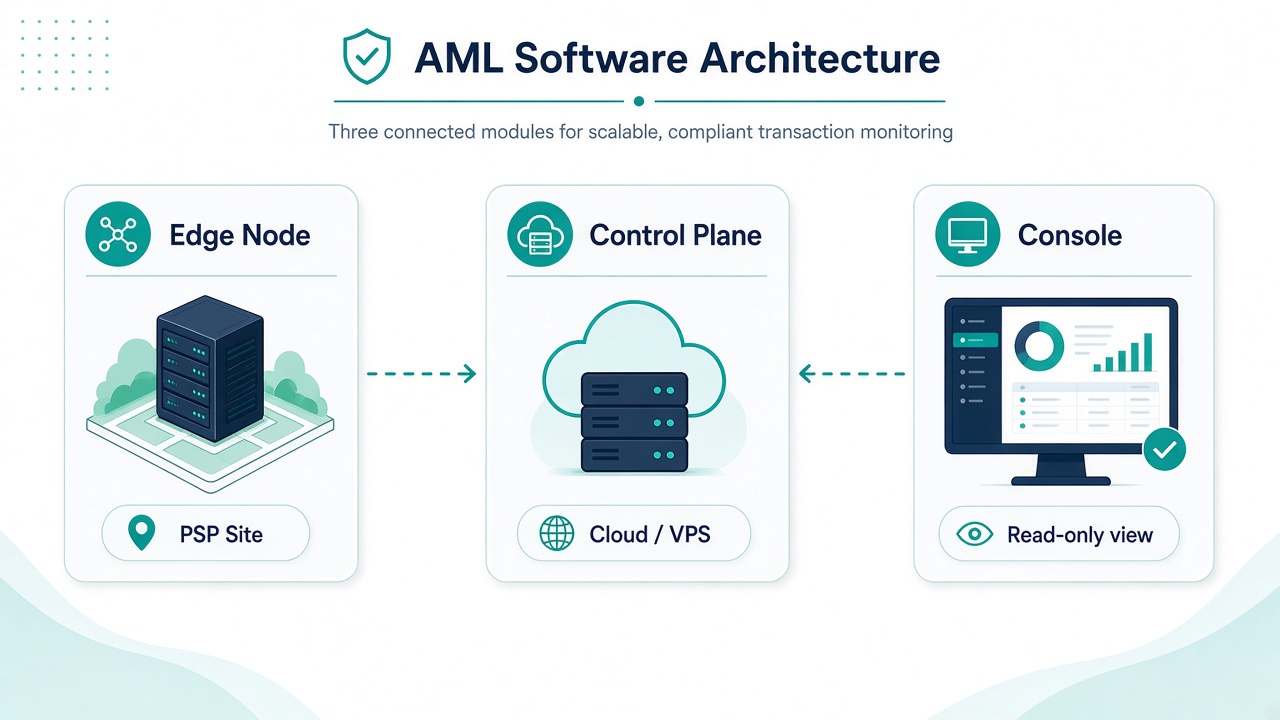
Figure 1 — The product at a glance. The Edge evaluates every transaction inside your estate and keeps the ledger; the Control Plane receives sealed decision records and raises alerts, cases and filings; the Console is the operator view. The only connection between the two halves is outbound TCP 443.
What you get (the offering)
| Capability | Where it runs | What it does |
|---|---|---|
| Real-time decisioning | Edge Node | Rules, velocity and risk thresholds evaluated per transaction with a deterministic decision (ALLOW / ALERT / HOLD / BLOCK) in the authorisation path |
| Site ledger | Edge Node | PostgreSQL 16 system of record for every evaluation, retained 5–25 years and purgeable on your terms |
| Audit trail | Edge Node | Decision records v2, sealed and queued in an outbox so nothing is lost across restarts or outages |
| Alerts, cases, investigations | Control Plane + Console | Queues, assignment, notes, SAR/STR/CTR workflow and filed-document storage |
| Screening data | Control Plane | Sanctions/PEP lists and list versioning, pushed to the Edge as a bundle |
| Rule management | Console | Rule authoring, versioning, maker-checker approval and effectiveness metrics |
| Fleet management | Console | Edge node enrolment, approval, health, bundles and upgrades |
| Advisory AI | Control Plane | Sanctions triage, SAR drafting and rule suggestions — never on the transaction path, never on your data at rest |
Start here
- Installing an Edge Node? → All installation methods — one-liner, Linux container, Linux native, air-gapped, multi-node site, Windows, fresh-OS bootstrap, prebuilt image. Per-OS support matrix included.
- Wiring a payment path? → How an evaluation works and the PSP API guide.
- Looking for an endpoint? → API overview and the Management API reference.
- "Why did my node answer HOLD?" → FAQ and install troubleshooting.
- New to the vocabulary? → Glossary.
The five invariants
- The Edge is the only evaluator. The PSP calls only
POST /edge/evaluate. - No transaction data leaves the site. Decision records carry ids and outcomes only.
- Fail-closed. An unapproved node, an unwritable ledger or a missing TLS keystore answers
HOLD— it never silently allows. - Artifacts are verified. Installers verify a GPG-signed
SHA256SUMSbefore trusting any digest. - Retention is a Console setting (5–25 years, maker-checker), enforced on the Edge Ledger.
How this site is built
Docusaurus. The process and reference pages are generated from the repository's docs/ Markdown
at build time, so there is one authoritative copy; the FAQ, overview and API landing pages are
hand-written; the Management API reference is generated from the checked-in OpenAPI document.